
What does “less likely to be bottlenecked” actually mean?
The phrase hides two different questions. The first is whether your CPU can feed the card: a stronger card needs the CPU to prepare more frames, so a weaker CPU is more likely to leave the stronger card waiting, especially at 1080p. The second is whether the card itself limits you: a weaker card reaches full load sooner, so it is more likely to be the limit at 1440p and 4K. A card can therefore be “less bottlenecked” in one sense and more limited in the other.
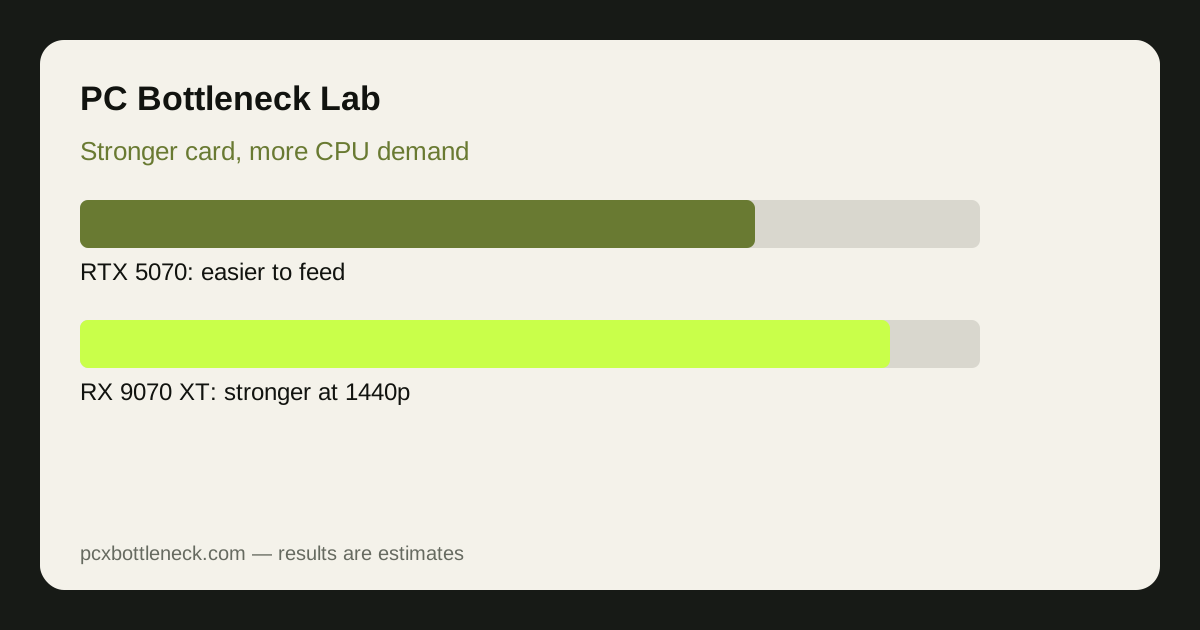
That distinction explains the headline answer. The 5070 is easier for a mid-range CPU to keep fed, so it shows a CPU bottleneck less often. The 9070 XT is less often the GPU limit at 1440p, so it delivers more headroom once the CPU is capable enough. Neither statement holds without naming the CPU, resolution and game type.
Our guide to CPU bottlenecks in esports versus AAA games makes the same point from the game side: the same pairing can be CPU-limited in one title and GPU-limited in another, so a single bottleneck label for a card is misleading.
How does your CPU change the answer?
With a strong current gaming CPU, the bottleneck question largely disappears for both cards at 1440p and above. The CPU can feed either card, both run near full load in demanding games, and the choice becomes about game performance, features and price rather than balance. With a mid-range CPU from the last few generations, the 9070 XT is somewhat more likely to wait at 1080p, while the 5070 is more likely to stay fully utilised.
With an older or entry-level CPU, both cards will wait in CPU-heavy games, but the stronger card wastes more of its potential there, which weakens its value case. In that situation, the 5070 is the more balanced purchase, or the CPU should be upgraded first. Run your exact pairing in the PC bottleneck calculator and check the ranges by resolution rather than guessing from the card name alone.
| Your CPU | RX 9070 XT | RTX 5070 |
|---|---|---|
| Strong current gaming CPU | Well fed at 1440p and 4K | Well fed everywhere |
| Mid-range CPU, recent | Some waiting at 1080p | Less waiting at 1080p |
| Older or entry-level CPU | Most potential unused in CPU games | Better balanced, still CPU-limited |
For reference, a RX 9070 XT bottleneck page and a RTX 5070 bottleneck page let you compare each card against your own processor directly.
Which card wins in which kind of game?
In traditional rasterised AAA games at 1440p, the 9070 XT generally has the edge, as a broad estimate in the region of a small to moderate frame-rate range advantage in GPU-limited scenes, with its extra graphics memory helping at high texture settings. In heavily ray-traced games, the 5070 generally closes that gap and can pull ahead, because its ray tracing and upscaling ecosystem is more mature in those titles. In esports games, both cards are usually fast enough that the CPU and monitor matter more than the card.
Features therefore belong in the decision alongside raw speed. If you value mature ray tracing, a widely supported upscaler and broadcast or creator features, the 5070 has a broader ecosystem case. If you mainly play rasterised AAA games at 1440p, want more memory headroom for high textures, and have a CPU that can feed it, the 9070 XT has a straightforward performance case. Neither advantage is universal.
Check the games you actually play, not a generic ranking. A card that wins on average can still lose in your favourite title if that title leans heavily on ray tracing or is CPU-limited on your processor.
Which card should you pick?
Pick the 9070 XT if you have a capable CPU, play at 1440p or above, mainly play rasterised AAA games, and want the stronger GPU-limited performance with more texture headroom. Pick the 5070 if your CPU is mid-range, you play at 1080p or 1440p, you value ray tracing and upscaling support, or the 9070 XT's advantage would mostly sit unused behind your processor.
Price at the moment of purchase can overturn either recommendation, so this article gives no price figure: check current pricing, warranty and cooler quality for the exact models you are comparing, not just the chip name. A well-cooled, fairly priced model of either card beats a hot, overpriced model of the “better” chip.
Finally, a bottleneck is not a defect: a GPU at full load is doing its job, and a CPU limit at 1080p that disappears at 1440p is normal. Our PC guides and blog cover how to read these patterns.
Limitation: performance ranges here are general estimates across game types, not measured results for any specific title, driver version or test system. Ray tracing, upscaling, RAM, cooling and CPU pairing all move the result. Verify with independent reviews for your games and current pricing before buying.
Frequently asked questions
Is the RX 9070 XT faster than the RTX 5070?
In traditional rasterised AAA games at 1440p, generally yes, by a small to moderate estimated range in GPU-limited scenes. In heavily ray-traced games, the 5070 often closes the gap or pulls ahead, so the winner depends entirely on the games you play most.
Will my CPU bottleneck an RX 9070 XT?
With a strong current gaming CPU, rarely at 1440p and above. With a mid-range or older CPU, more often at 1080p and in CPU-heavy games, where the card may wait. Run your exact CPU and GPU pairing in the calculator to see the ranges by resolution.
Is the RTX 5070 easier to pair with a mid-range CPU?
Yes, slightly. Because it asks a little less of the processor, a mid-range CPU is less likely to leave it waiting at 1080p. That makes it the more balanced choice when a CPU upgrade is not planned in the near future.
Which card is better for ray tracing?
The RTX 5070 generally has the stronger case in heavily ray-traced titles, thanks to more mature ray tracing performance and a widely supported upscaling ecosystem. If ray tracing is a priority, weigh that advantage against the 9070 XT's rasterised performance.
Does more graphics memory make the 9070 XT future-proof?
It helps with high texture settings and higher resolutions, where memory pressure appears first, but it does not guarantee future performance on its own. Chip speed, driver support and game optimisation matter just as much over a card's whole lifetime.