
What actually separates the two cards?
The Ti sits one tier above the base 5070, with a stronger graphics chip and more graphics memory. In practice that means two advantages rather than one: higher frame rates in GPU-heavy scenes, and more headroom when texture quality, resolution or ray tracing rises. The second advantage matters more over time, because a card that is comfortable today can become memory-constrained as games use larger textures.
That does not make the base 5070 weak. It is a capable 1440p card, and in lighter or esports titles it will often reach the same high refresh rates as the Ti, because those games are limited by the CPU or the monitor's refresh rate long before either GPU is fully loaded.
If your games already run GPU-limited, the Ti buys real performance. If they run CPU-limited, both cards wait on the same processor, and the extra money buys little until the CPU is upgraded too.
How does the gap change by resolution?
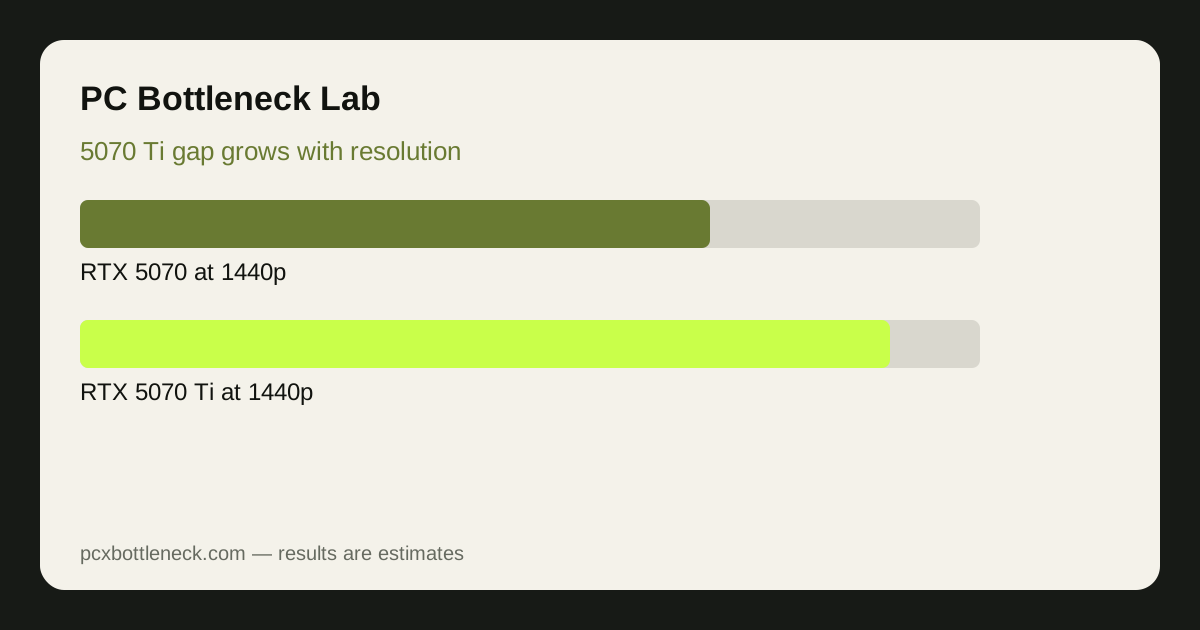
Resolution is the biggest lever on this comparison. At 1080p, both cards finish frames quickly, so the CPU and the game engine set the pace in many titles, and the measured gap between the two cards narrows to a modest range. At 1440p, the GPU works harder, the Ti's stronger chip shows, and the gap widens to a clearly noticeable range in demanding games. At 4K, the gap is at its widest, because shading load dominates and the base card is under the most pressure.
| Resolution and use | RTX 5070 | RTX 5070 Ti |
|---|---|---|
| 1080p esports / high refresh | Usually enough; CPU often limits both | Little extra in CPU-limited titles |
| 1440p AAA, high settings | Comfortable in most games | Noticeably smoother in demanding scenes |
| 4K, high settings | Often needs settings lowered | More headroom, still not unlimited |
| High texture / ray tracing load | Memory pressure appears sooner | Extra memory headroom helps |
As a rough guide only, and labelled as an estimate rather than a measured result, the Ti's advantage in GPU-limited AAA games is often in the region of a 10–25% higher frame-rate range at 1440p and above, shrinking to a small single-digit to low-teens range at 1080p where the CPU intervenes. Individual games, drivers and settings move this range in both directions.
Which CPU pairing makes sense for each card?
A strong current gaming CPU suits both cards, but the Ti benefits more from one, because a faster CPU lets the stronger GPU show its advantage at 1440p instead of waiting. With an older mid-range CPU, the Ti's extra performance is partly hidden at 1080p and in CPU-heavy games, which weakens its value case until the CPU is also upgraded.
For a concrete check, compare the RTX 5070 bottleneck page and the RTX 5070 Ti bottleneck page against your own processor, or run your exact pairing in the PC bottleneck calculator. If the calculator shows a CPU limit at your resolution for the Ti but not for the base card, that is a sign to either pair the Ti with a stronger CPU or save the difference.
Slow single-channel RAM can hold back both cards equally, while a throttling CPU hides the Ti's advantage entirely. Check those first, as our guide to CPU usage at 100% with low GPU usage explains.
Which card is the better value, and for whom?
Value depends on the price gap at the moment you buy, which changes with stock and retailer pricing, so this article deliberately gives no price figure. As a rule, the base 5070 is the better value if you play at 1080p or 1440p with a mid-range CPU, play mostly lighter games, or plan to upgrade the GPU again sooner. The Ti is the better value if you play at 1440p high refresh or 4K, keep cards for several years, or play demanding games with heavy textures and ray tracing.
Consider total cost as well. A Ti paired with an older CPU may push you towards a CPU upgrade to unlock it, while a base 5070 in the same PC may already be balanced. Match the card to how long you intend to keep it.
Our PC guides and blog cover the wider upgrade question, but the short version is this: at 1080p, save the difference; at 1440p and above with a capable CPU, the Ti earns its premium in the games that actually stress a GPU.
Limitation: frame-rate ranges here are general estimates for GPU-limited AAA games, not measured results for any specific title, driver version or test system. Settings, game engine, RAM, cooling and CPU pairing all shift the gap. Check current pricing and independent reviews for the games you play before buying.
Frequently asked questions
Is the RTX 5070 Ti much faster than the RTX 5070?
In GPU-limited AAA games at 1440p and above, yes, by a noticeable estimated range, roughly 10–25% higher frame rates in demanding scenes. At 1080p or in CPU-limited games, the gap shrinks a lot, because both cards end up waiting on the same processor.
Do I need a better CPU for the RTX 5070 Ti?
You do not strictly need one, but a stronger current gaming CPU helps the Ti show its advantage, especially at 1440p. With an older mid-range CPU, part of the Ti's extra performance stays hidden at 1080p and in CPU-heavy titles.
Is the RTX 5070 enough for 1440p gaming?
For most games at high settings, yes. It is a capable 1440p card, and only the most demanding titles with heavy textures or ray tracing will push it towards lowered settings. If you play mainly at 1440p, it remains a sensible, balanced choice.
Is the RTX 5070 Ti worth it for 4K gaming?
It is the stronger choice of the two for 4K, with more headroom at high settings, but neither card makes every AAA game effortless at 4K. Expect to adjust settings in the heaviest titles, and weigh the Ti against higher-tier cards if 4K high refresh is your main goal.
Which card should I buy if I play esports games?
Usually the base 5070, because esports titles are often CPU-limited and both cards can reach high refresh rates there. Spend the saved difference on a faster CPU, faster RAM or a higher refresh monitor, which will affect esports performance more directly.